Author:
Ms Komal
Artificial
Intelligence has become one of the most powerful technologies of our time. From
writing assignments and creating presentations to solving problems and
generating ideas, AI can accomplish tasks within seconds that once required
hours of human effort. While this convenience is undoubtedly valuable, it also
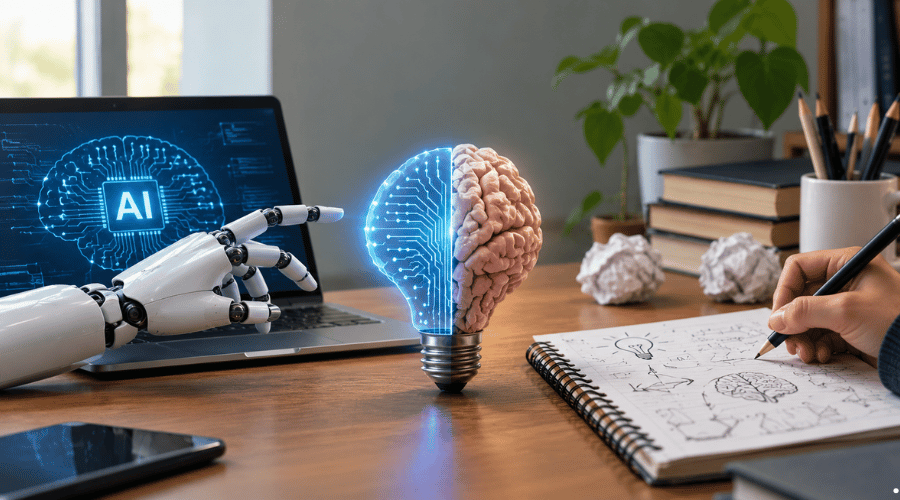
raises an important question: Are we using AI to think better, or are we slowly
allowing it to think for us?
The
real danger of AI may not be that machines will become more intelligent than
humans. It may be that humans will gradually become less willing to think
independently.
From
Assistance to Dependence
AI
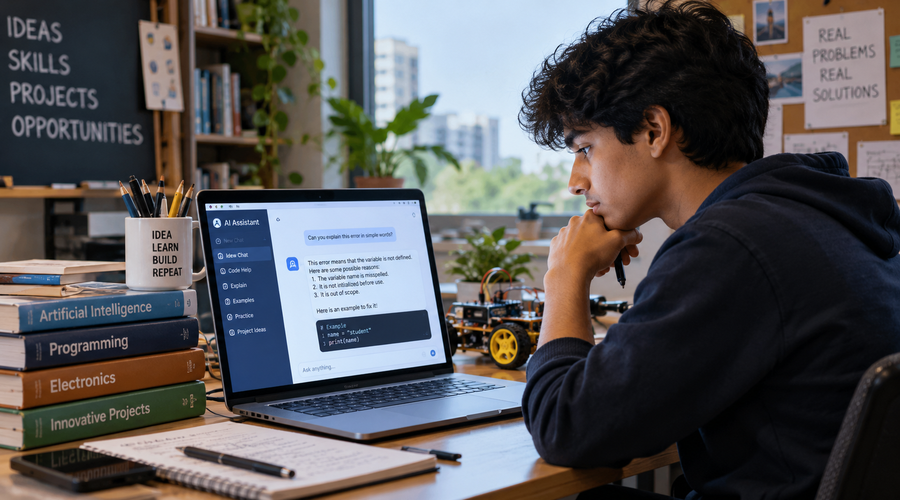
is designed to assist us. A student can use it to understand a difficult
concept, a programmer can use it to identify an error, and a writer can use it
to improve an idea. When used in this way, AI can enhance human abilities.
The
problem begins when assistance becomes dependence. Instead of attempting a
problem, we may immediately ask AI for the solution. Instead of developing our
own ideas, we may ask AI to generate them. Over time, this can create a habit
of avoiding the mental effort that is necessary for learning and
problem-solving.
Thinking
is like a skill: it becomes stronger through practice. If we constantly allow
AI to do the difficult part, we may become less confident in doing it
ourselves.
The
Impact on Students
The
effect can be particularly significant in education. Students can now generate
essays, solve mathematical problems, write programs, summarise books, and
prepare presentations with minimal effort. Although these tools can support
learning, using them as a substitute for learning defeats the purpose of
education.
A
student who receives an answer instantly may complete an assignment, but may
not develop the ability to reach that answer independently. The result can be a
generation that is highly skilled at using technology but less comfortable with
questioning, reasoning, and solving unfamiliar problems. Education should not
simply be about producing correct answers. It should teach us how to think,
question, analyse, and create.
What
About Creativity?
AI
can produce stories, poems, images, music, and designs in seconds. This raises
another concern: what happens to human creativity when we increasingly depend
on machines for ideas?
Creativity
often comes from experimentation, mistakes, personal experiences, and even
moments of frustration. If we always choose the fastest AI-generated solution,
we may miss the process through which truly original ideas develop. The danger
is not that AI will eliminate creativity overnight. Instead, human creativity
could slowly become less practised because convenience becomes more attractive
than experimentation.
We
Should Not Fear AI—We Should Use It Wisely
AI
itself is not the enemy. Like any powerful tool, its impact depends on how we
use it. Asking AI to explain a difficult topic can improve understanding. Using
it to receive feedback can improve our work. Brainstorming with AI can even
help us explore ideas we might not have considered. The important distinction
is between using AI as a thinking partner and using it as a replacement for
thinking. We should question its answers, verify important information, develop
our own opinions, and attempt problems before asking for solutions. AI should
make human thinking more powerful—not make human thinking unnecessary.
Conclusion
The
future of AI does not have to be a future without original thought. The choice
is still ours. We can use AI to save time while continuing to learn, question,
create, and reason for ourselves. Or we can become so dependent on convenience
that we gradually stop doing the very things that make us human. Perhaps the
greatest danger of AI is not that machines will learn to think like humans, but
that humans may slowly forget how to think for themselves.