From
Understanding a Lesson to Building Real-World Solutions
By Ahan Raj
B.TECH 2nd year student
CSE Branch, Puran Murti Vidyapeeth
ahanr1152@gmail.com
When One Explanation Is Not Enough
Every student has faced a lesson that did not make sense the
first time. Sometimes the textbook language is difficult, and sometimes the
class moves on before we have understood. Many families in India solve this
with private coaching. A 2025 government survey by the National Statistics
Office found that 27% of students take it, and urban families spend about
₹4,000 a year per student on it, compared with about ₹1,800 in rural areas.
This shows how much students need extra help, and how much families are ready
to pay for it.
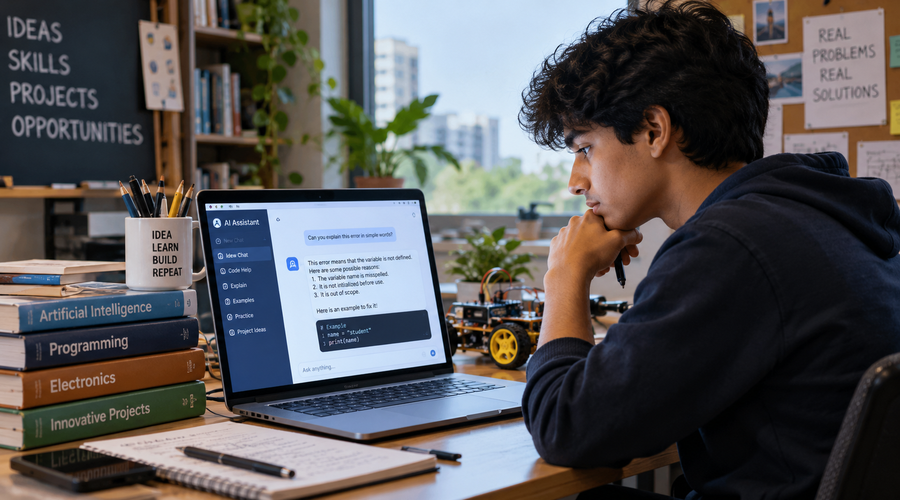
AI offers another way to get that help. A student can ask it
to explain an idea in simpler words, give an example, break a topic into small
steps or create practice questions. If the answer is still confusing, the
student can ask again in a different way, at any time of the day. AI does not
replace teachers, who give guidance that a tool cannot. But it means a doubt no
longer has to stay unanswered until the next class.
From Understanding to Building
Learning does not have to stop at understanding a concept.
AI can also help students use what they learn to build something real. For
example, a student interested in agriculture could make a small system that measures
soil moisture and tells a farmer when the plants need water. The student still
plans and tests the system, while AI helps explain errors, suggest improvements
and make the project easier to use. The same idea works for problems in health,
road safety, waste management or saving energy.
I have seen this in my own learning. While building web
projects for hackathons, I often got stuck on errors that I could not
understand. When I asked AI to explain the error step by step, I understood the
reason behind it and fixed it myself. I still had to test everything and decide
what to build, but I spent less time being stuck and more time building.
Why This Matters for India's Economy
Skills decide what a student can do after college, and the
cost of learning them matters to families. If AI helps a student understand a
topic without paying for extra classes every time, the family saves money. If
the student also learns to build useful projects, they become more ready for
internships, jobs or freelance work. When many young people can learn quickly
and solve real problems, the whole country benefits.
Using AI the Right Way
AI is helpful, but it is not always correct. It can give
wrong facts or code that does not work, so students should test the answers and
make sure they understand any work they submit. Copying a solution may finish
the task, but it does not build the skill needed for the next problem. A good
habit is to try first, use AI when stuck, and then check the explanation on
your own.
Access is another concern. According to UDISE+ 2024-25,
about 63.5% of schools in India have internet, which means more than one in
three still do not. If only students with good devices and connections can use
AI, the gap between students will grow instead of shrinking. UNESCO also says
that AI in education should support students instead of replacing their effort,
and that teachers need training to use it well.
Conclusion
AI is making it easier to get explanations, explore beyond
the syllabus and build practical projects. But its real value depends on how we
use it. The future belongs not to students who simply use AI, but to those who
use it thoughtfully, check what they learn and keep building with their own
hands and minds. If access becomes fair, AI can help prepare students not only
for exams, but also for the real problems waiting outside the classroom.