Author- Dr. Monika
Email ID: monikajoon30@gmail.com
Puran Murti College of Law
INTRODUCTION:
Today’s world is considered a world of technological
development. The use of various technologies in almost all fields is common
these days. Artificial Intelligence (hereinafter referred to as AI) is
also one of them. The development of AI has raised an important question under
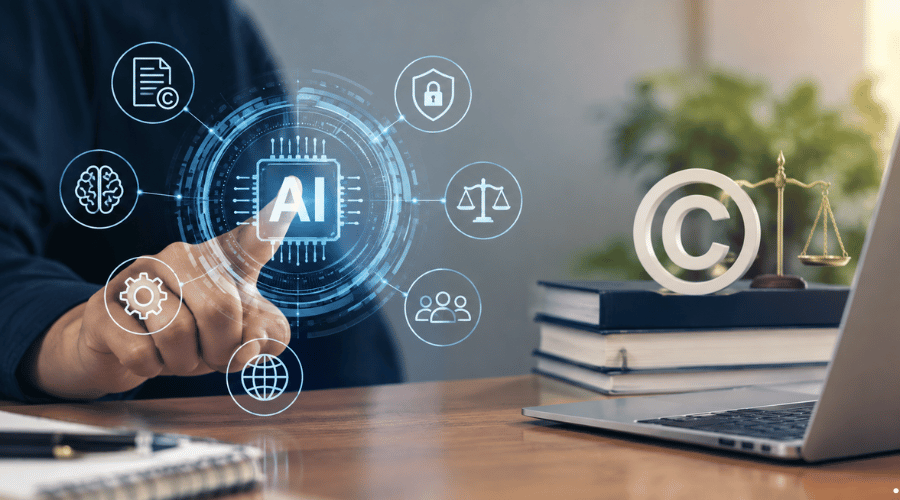
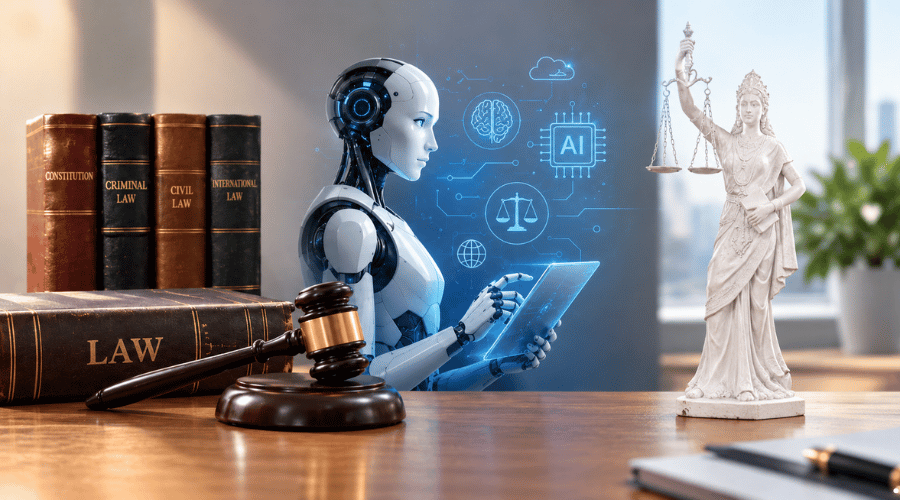
Intellectual Property Rights (IPR). AI has the potential to create content like
music, lyrics, and pictures on its own even without receiving any outside
input. Traditionally, copyright protects the intellectual work created by human
beings. Copyright law provides authorship to the creator of original literary,
artistic, musical and dramatic works. Now, due to the emergence of technology,
machines have the capability to create novel content like original copyright
work, which is protected by the copyright law of a nation. However, it becomes
more challenging to determine authorship in an AI-generated work.
COPYRIGHT PROTECTION UNDER INDIAN LAW:
The Copyright Act, 1957 governs the copyright regime in India.
The Act grants copyright protection to literary, dramatic, musical, and
artistic works, cinematograph films, and sound recordings. The use of
technology in the production of works of authorship is not new. Authors
have used computer-assisted technology for decades to enhance, modify, and add
to their creations—expanding their range of expression and advancing the goals
of the copyright system.
But the capabilities of the latest generative AI technologies
raise challenging questions about the nature and scope of human
authorship. These technologies now permit the creation of textual,
visual, and sound outputs that resemble the creative works traditionally
protected by copyright. Should these outputs also enjoy copyright
protection?
ESSENTIALS FOR COPYRIGHT PROTECTION:
As per Indian law, the following are the essentials to get
protection under copyright law:
1. The work should be expressed.
2. The work should be original.
3. The work should be in some tangible form.
4. It should be created by human intellect.
DEFINITION OF AUTHOR:
Section 2(d) (vi): Definition of Author of computer-generated
work
Section 2(d) (vi)
provides:
In relation to any literary, dramatic, musical or artistic work
which is computer-generated, the person who causes the work to be created shall
be the author.
The existing definition does not expressly recognise AI as an
author. It requires human intervention to get copyright protection. AI has the
capacity or potential to create its own content without human intervention.
Here the question arises: what would be the status of AI-generated work?
The copyright protection of AI work under different
international statutes-
U.S.A. copyright law does not provide copyright to AI-generated
work. It provides copyright to the work that is created with the intervention
of a human being.
U.K. copyright law gives joint authorship to AI-generated work.
SEC 17-THE FIRST OWNERSHIP OF COPYRIGHT:
Sec.17 provides the author as the first owner of copyright that
is subject to certain statutory exceptions.
In relation to AI-generated work, the first ownership depends
upon identifying the legally recognised author. The existing definition does not
expressly recognise AI as an author. It requires human intervention to get
copyright protection. AI has the capacity or potential to create its own
content without human intervention. Here, the question arises: what would be
the status of AI-generated work?
Thus, identifying the person who caused the creation of a work
is a main step in determining copyright ownership.
CHALLENGES IN GRANTING COPYRIGHT TO AI- GENERATED WORK:
As the Indian Statutory Law relating to copyright does not
recognise authorship of AI-generated work. It provides copyright to the
intellectual creation of human minds. Certain major challenges in granting
copyright to AI are as follows-
1. Absence of human
intervention because AI has the potential to create on its own.
2. Determination of
originality in AI-generated work is a difficult task.
3. Determination of
creativity.
4. Determination of
ownership.
5. Infringement of
existing copyright, as copyrighted work is used to train AI models. Who will take 6. responsibility for copyright infringement?
6. No clear statutory
guidelines regarding authorship and ownership of AI-generated work.
7. Duration for
AI-generated work.
POSSIBILITIES TO GET COPYRIGHT PROTECTION FOR
AI:
The Copyright Act, 1957 was framed when the technology was not
so developed, and it does not provide copyright to AI-generated work. However,
there are some possibilities to give copyright to AI-generated work.
1. By amending the
statutory definition of Author.
2. By inserting a clear
definition of AI-generated work.
3. By providing some
major guidelines regarding the involvement of a human being in the creation of
AI work.
4. By providing a human
creativity test.
5. To provide joint
authorship to it.
CONCLUSION:
AI is booming in the
present era. The possibility of providing copyright to AI-generated or
machine-made work is quite difficult for the legislature. The potential of AI
to create on its own without human intervention raises the most significant
challenge in contemporary intellectual property law. Traditional statutory law
protects the original creation in some tangible form by human beings. There is
no copyright protection for work solely created by machines. Somewhere, it
requires human intervention. However, there are some possibilities to recognise
AI-generated work as copyright. It is the need of the hour to amend the
existing legal rules related to copyright to keep pace with technology. There
is a need to develop a clear legal framework that balances innovation, human
creativity, ownership and authorship rights and public interest.