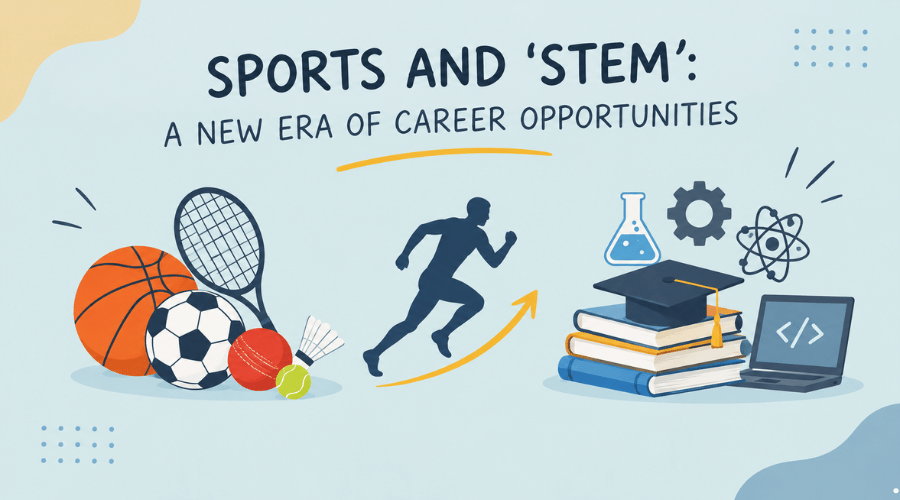
SPORTS AND ‘STEM’: A NEW ERA OF CAREER OPPORTUNITIES
Mr. Vijay Rana
Sports Manager, Puran Murti Vidyapeeth
E-mail: vrana717@gmail.com
For many years, the domains of rigorous academic science and athletics were distinct. While the scientist oversaw labs, mathematical models, and controlled tests, the athlete's domain was defined by physical effort, muscle memory, and field instinct. That queue has completely vanished today. Science, Technology, Engineering, and Mathematics (STEM) are the main forces behind athletic success, injury prevention, and fan engagement in today's high-tech sports ecosystem.
A new era of job opportunities has been sparked by this convergence, where a love of sports and cutting-edge technical know-how combine to create exciting career paths for the upcoming generation of professionals.
1. Biomechanics and Sports Science: Decoding Human Kinetic Potential
Biomechanics and sports science are fields that reside at the nexus of biology, physics, and mechanical engineering. While modern performance analysis depends on accurate quantitative technology, traditional coaching mostly depended on qualitative visual observation.
• Wearable Sensor Engineering: To track physiological stress in real time, biomedical engineers create GPS tracking units, heart-rate variability monitors, and micro-electromechanical systems (MEMS) that are directly integrated into sportswear.
• Kinematic Optimisation: Sports scientists methodically improve movement efficiency while reducing injury risks by analysing joint torques, ground reaction forces, and stride mechanics using high-speed computer vision and motion-capture technology.
• Rehabilitation and Orthotics: Custom, energy-returning orthotic devices and sophisticated prosthetic limbs are created by biomedical 1 engineers and prosthetists, enabling adaptive athletes to attain previously unheard-of kinetic efficiency.
2. Applied Mathematics and Data Science: The Algorithmic Strategy
Competitive game plans and roster construction have become applied mathematics fields due to the proliferation of real-time spatial data. These days, every major international league has specialised analytics departments run by statisticians, computer scientists, and software engineers. Using machine learning, data scientists create predictive algorithms to assess player trajectories, model tactical matchups, and spot underappreciated talent. Simultaneously, computer vision experts filter live broadcast feeds using neural networks, transforming unprocessed footage into continuous coordinates that map athletic workload and spatial awareness. As a result, tactical decision-making has developed into an ongoing synthesis of algorithmic insights derived from data and human intuition.
3. Material Science and Structural Physics: Equipment Engineering
Modern sporting equipment is the result of ongoing material synthesis and mechanical design, from protective headgear and ball dynamics to aerodynamic jerseys and performance shoes. To optimise energy transfer and velocity, chemical and material engineers create carbon-fibre composites, energy-returning foam polymers, and drag-reducing fabrics. Aeronautical and mechanical engineers use wind-tunnel testing and computational fluid dynamics to optimise equipment flight characteristics and guarantee aerodynamic precision in a variety of climatic circumstances. Additionally, impact mechanics is used by mechanical engineers to create protective padding and helmet designs that can absorb rotational pressures, hence improving athletes' long-term neurological safety.
4. Infrastructure and Systems Engineering: Smart Venues and Immersive Media
Beyond individual players, STEM in sports has an impact on the physical stadiums and online media platforms that showcase competition to audiences 2 around the world. Intelligent, sustainable venues with retractable roofs, climate-controlled turf systems, and automated crowd-management structures are designed by civil, structural, and electrical experts working together. At the same time, real-time biometric measures, low-latency streaming infrastructure, and augmented reality overlays are being developed by software developers, network architects, and broadcast engineers. The contemporary venue functions as an integrated laboratory where digital media, Internet of Things technology, and civil engineering come together to transform the production, analysis, and experience of sport.
Conclusion: Bridging Technical Rigour and Athletic Endeavour
The combination of STEM and sports shows how technical fields find some of their most exciting, high-stakes uses in athletics. A job in STEM no longer necessitates putting aside a passion for sports; rather, it enables people to become the scientists, engineers, and data architects who rethink what is strategically and physically feasible. The nexus of sports and STEM offers a previously unheard-of level of professional fulfilment for students and academics looking for a future of technical rigour, innovative problem-solving, and instant real-world effect.