Author: Dr. Sonia
Email ID: soniadahiya26@gmail.com
Puran Murti College of
Law
Introduction
The legal system has
always evolved alongside society. From handwritten records to electronic
filing, virtual hearings and artificial intelligence, technology is gradually transforming
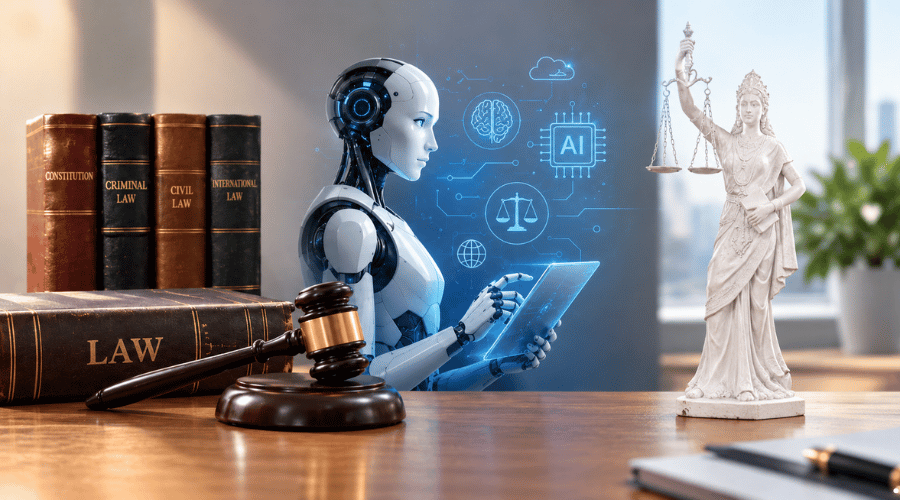
the way law is understood, practised, and administered. The image of Lady
Justice holding the Constitution of India in one hand and the scales of justice
in the other beautifully represents this transformation. Today, technology is no longer merely a
supporting tool for lawyers and courts. Artificial Intelligence, cloud
computing, biometrics, digital evidence, and cybersecurity are becoming
increasingly relevant to the legal profession. These technologies can make
legal services more accessible and efficient, but they also create difficult
questions concerning privacy, accountability, bias, security and human rights.
The future of justice
will therefore depend not simply on adopting technology, but on ensuring that
technology operates within the framework of constitutional values, legal
safeguards and human dignity.
Artificial Intelligence
and the Changing Legal Profession:
Artificial Intelligence
is one of the most significant technological developments affecting the legal
sector. AI-based systems can analyse large volumes of legal documents, identify
relevant provisions, assist in legal research and organise information in
considerably less time than traditional manual methods. For lawyers, technology
can assist with legal research, contract analysis, document review, case
management and due diligence. Instead of spending hours searching through
thousands of pages, lawyers can increasingly use digital tools to locate
relevant information and precedents.
However, AI should be
viewed as an assistance mechanism rather than a replacement for legal judgment.
Legal decision-making involves interpretation, context, ethics, fairness and an
understanding of human circumstances.
An important question
for the future is therefore not “Can AI replace lawyers?” but rather: “How can
lawyers use AI responsibly while preserving professional judgment and
accountability?”
Digital Evidence
Modern disputes
increasingly involve digital material. Emails, CCTV recordings, mobile-phone
data, social-media posts, GPS information, electronic transactions and
digitally stored documents may all become relevant in legal proceedings. The
increasing importance of digital evidence has changed the traditional concept
of proof. A document is no longer necessarily a physical piece of paper; it may
exist entirely in electronic form.
This development brings
several challenges. Courts and investigators must consider questions such as:
Is
the digital evidence authentic?
Has
it been altered or manipulated?
Who
created or controlled the data?
The reliability of
digital evidence is particularly important in an era of AI-generated content
and deepfakes. A photograph, audio recording or video can potentially be
manipulated in sophisticated ways. Consequently, legal systems must continue
developing reliable methods for authentication and verification.
Right to Privacy and Data
Protection
Technology has made the
collection and processing of personal information easier than ever. Every
digital interaction can potentially generate data: search histories, location
information, biometric identifiers, financial information and online behaviour.
Technology
should collect only necessary personal information.
Personal
data should be used safely and transparently.
Innovation
should be balanced with the right to privacy.
Technology should make
life easier—not reduce an individual's control over their own personal
information.
Cybersecurity and the
Digital Justice System
As courts, law firms,
government departments and businesses become increasingly digital,
cybersecurity becomes an essential component of the justice system.
Cyberattacks can affect confidential legal documents, personal information,
financial records and sensitive case materials. A security breach may therefore
have consequences extending far beyond financial loss.
Client
information and digital communication should be kept secure.
Strong
authentication, regular security checks, and awareness of cyber threats are
necessary.
Electronic
evidence should be handled responsibly, with proper measures for responding to
security incidents.
Technology and Access to
Justice
One of the greatest
promises of legal technology is the possibility of making justice more
accessible. Virtual hearings, online legal information, electronic filing and
digital communication can reduce geographical barriers and save time and
resources. For individuals who cannot easily travel to courts or legal
institutions, technology can provide new avenues for accessing legal services.
Legal technology can
also contribute to legal literacy. Citizens can access information about their
rights, procedures and available remedies through digital platforms. Therefore,
technology should expand access to justice rather than create a new barrier to
justice.
The Human Element: Why
Technology Cannot Replace Justice
Technology can help
lawyers and courts, but it cannot fully understand human values like fairness,
dignity and compassion. Therefore, human judgment and oversight are essential
to ensure true justice.
Justice
needs human values like fairness, equality, dignity and compassion.
Technology
can assist legal work, but human oversight is necessary to prevent errors
and discrimination.
Future
lawyers need both legal knowledge and understanding of AI, cybersecurity,
data protection and digital evidence.
Ethical Challenges of
Technology in Law
The adoption of technology must be accompanied by ethical safeguards. Several
concerns deserve careful consideration.
AI
can create bias if it is trained on biased data.
Important
decisions should be transparent and have clear accountability.
Lawyers
must protect confidential information while using technology.
Human
supervision is necessary because technology should support, not replace,
legal judgment.
Technology must serve
the law—not replace the values that give law its legitimacy.
The Future of Justice
The courtroom of the
future may be shaped by technology, with lawyers using AI-powered research tools,
digital evidence becoming more common, hearings taking place partly online,
blockchain supporting record management, and citizens accessing basic legal
information through digital platforms. However, the core principles of justice
represented by Lady Justice will remain unchanged: the scales symbolise balance
and fairness, the Constitution represents the rule of law, and justice demands
equality and protection of rights. Technology can make the legal system faster,
more connected, and accessible, but efficiency must not come at the cost of
fairness or fundamental rights. The aim should therefore be to use technology
responsibly to strengthen and improve the justice system, rather than adopting
technology simply because it is available.
Conclusion
The relationship between
law and technology is no longer a question of the distant future. It is already
shaping the present legal landscape. For law students, this transformation
presents both an opportunity and a responsibility. The lawyers of tomorrow must
become technologically aware while remaining firmly grounded in constitutional
principles and professional ethics. Ultimately, technology should be the
instrument of justice, not the substitute for justice.
“The future of justice
is not about choosing between law and technology; it is about making technology
work for law, rights and humanity.”